- Solutions For
Specialist IT Support Services for:
- Security
Security
- Our Expertise
Our Full Range of IT Services

 IT Support Service Desk
 IT Infrastructure Services
 Remote Monitoring & Management (RMM)
 Cloud Solutions for Business
 Business Continuity & Backup Services
 Cyber Security Services
 IT Consultancy Services
 Microsoft 365 Solutions
 Perimeter Firewall Security Services
 Network & Data Security Services
 IT Audits for Business
 Dark Web Monitoring Services
 User Security Awareness Training
 Endpoint Security Services
 vCIO & CIO Services
 Mobile Device Management Services
 Managed Wi-Fi Solutions
 Cyber Essentials Certification for Law Firms
Posted 2nd July 2026
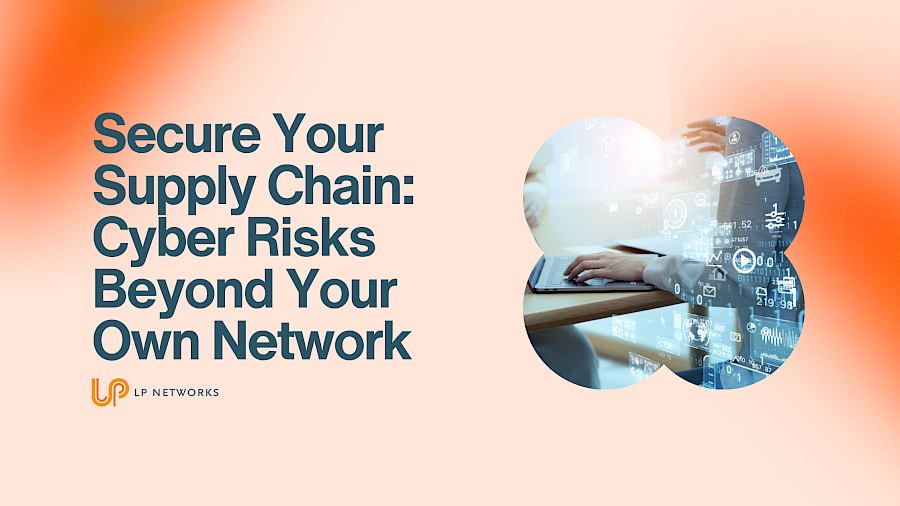
Most businesses focus their cyber security efforts on protecting their own network. Firewalls, antivirus tools, user permissions, and password policies usually form the backbone of that strategy.
But here is the uncomfortable reality. Even with strong internal defences, your business can still be compromised through a third party.
Your supply chain, including suppliers, vendors, software providers, and service partners, is now one of the most targeted entry points for cyber attackers.
And many organisations are not fully prepared for it.
According to Argon’s security review, following on from the COVID-19 pandemic, supply chain attacks grew by over 300 percent, highlighting just how rapidly this threat has escalated and why it now demands serious attention from businesses of all sizes.
Cyber criminals are opportunistic. If they cannot easily breach a well-defended organisation, they look for weaker links connected to it.
Those weaker links are often external suppliers who already have trusted access into your systems.
Once access is gained through a third party, attackers can move laterally into your environment without needing to break through your primary defences.
Common reasons supply chain attacks are rising include:
In short, businesses are more connected than ever, which means there are more potential entry points than most organisations realise.
One of the biggest challenges with supply chain security is visibility.
You can control your own network, but you cannot always control how secure your suppliers are.
Even a trusted provider can become a risk if their systems are compromised.
This creates blind spots in areas such as:
Without proper oversight, businesses often underestimate how much access external organisations actually have.
When supply chain attacks happen, the impact can be significant.
They often lead to:
Unlike direct attacks, supply chain breaches can spread quickly and quietly before they are detected.
While supply chain risk cannot be eliminated entirely, it can be significantly reduced with the right approach.
Here are key steps businesses should take:
Do not assume vendors are secure by default. Review their security posture, certifications, and data handling practices.
Only give third parties the access they need to perform their function. Remove unnecessary permissions and review them regularly.
Multi-factor authentication and strict access policies should apply to all external connections, not just internal users.
Keep visibility over what external providers are doing within your systems. Logging and alerting are essential.
If a supplier is compromised, you need a clear plan for how to respond quickly and contain the impact.
Modern businesses rely on complex networks of suppliers and digital tools. That dependency is not going away.
The goal is not to remove third-party relationships, but to manage them more securely and intentionally.
A strong supply chain security strategy ensures that every connection into your business is considered, controlled, and continuously reviewed.
Cyber security is no longer just about protecting your own network. It is about understanding every organisation that has access to it.
Supply chain risk is one of the fastest growing threats facing UK businesses, yet it remains one of the least visible.
At LP Networks, we help businesses strengthen not just their internal security, but their entire digital ecosystem. From supplier risk assessments to managed security monitoring and access control strategies, we make sure your business is protected beyond its own perimeter.
Get in touch with LP Networks to find out how we can help you identify risks, improve visibility, and secure every connection into your business.